Every fund you manage. Every holding, listed or private. One page, every morning.
Listed shares, SPV interests and direct private stakes, valued as your administrator values them, with the investors, offers and research behind each name.
- Listed and private together
- Offers graded against the round that followed
- Statements reconciled to the cent
In thirty seconds
- Who it is for
- Fund managers and family offices holding listed shares and private companies, often through SPVs.
- The problem
- Today those live in four places, and no page shows the whole fund.
- What it does
- CapCentral values every holding as your administrator does and reconciles each statement to the cent. Each company gets one page: rounds, offers and research on one chart, each offer graded against the round that followed. Investors and lock-ups sit beside the holdings, and a morning wrap says what changed overnight.
- What it costs
- From US$29 a month; US$199 for a fund, US$149 for founding members, fixed for two years.
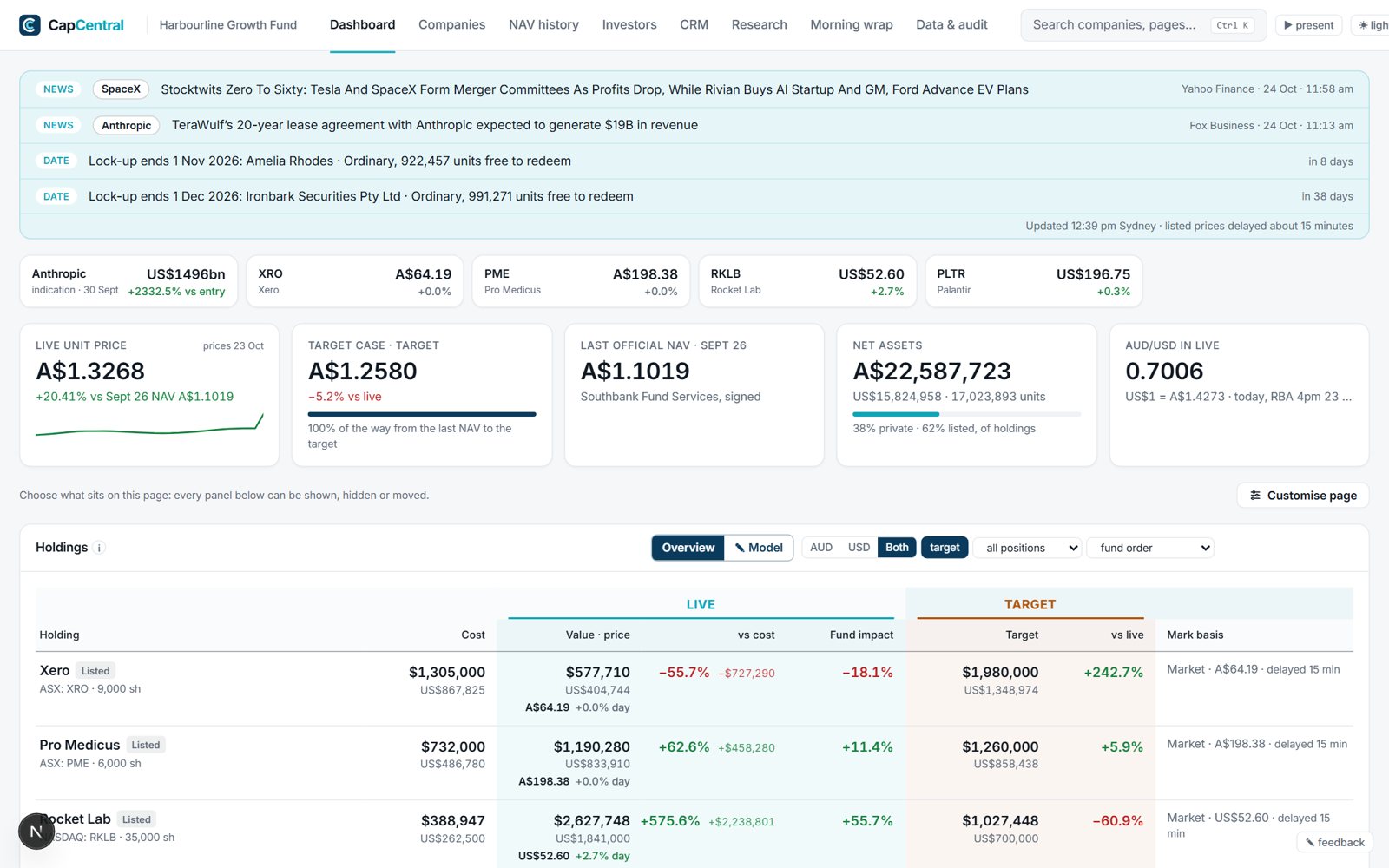
A look inside, on a demonstration fund.
Harbourline Capital is one of four fictitious funds we test on: real company names, invented positions, invented people. Click any picture to enlarge it.
Dashboard
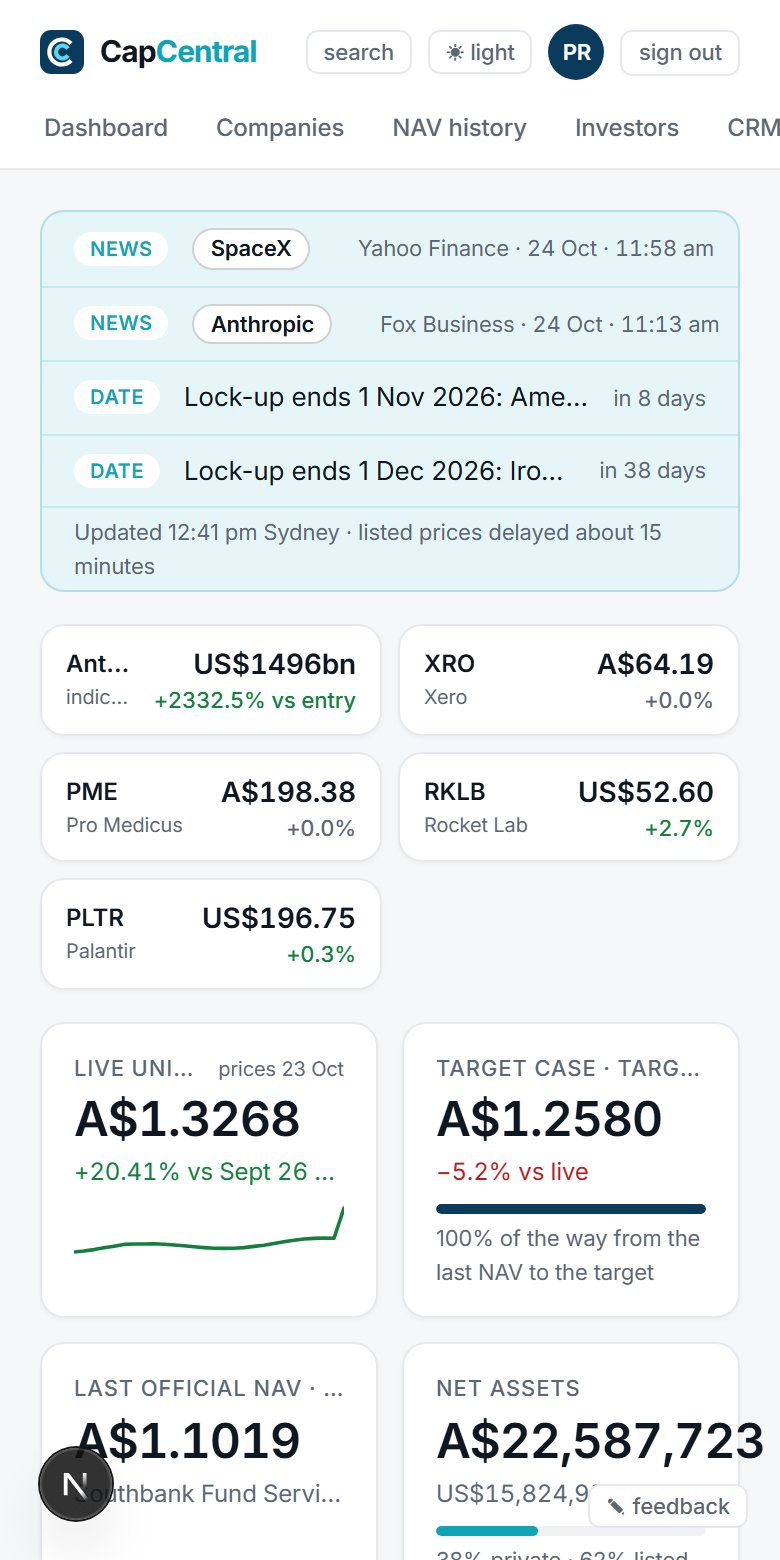
Day moves for the listed book, the latest round or offer for each private name, live unit price against the last signed NAV, and every holding's live and target value and effect on the fund.
Built with numbers, together.
Each fund keeps its own silo: positions, investors, documents and licensed wording stay yours. Members share only dated facts, never files: a round closed, an offer at this price, a call met or missed. The facts pool anonymously and every page improves with each member. A co-operative on data, with no one's IP on the table.
Offers versus outcomes
Every broker offer, dated and priced, graded against the round that followed. One fund's offer is everyone's data point; brokers are named only if they choose.
Rounds, once
A company's funding history is found once and shown to every member, with its source. Add a company and its history arrives with it.
Research with a scorecard
Calls scored against their own level and date. Licensed research stays private; only its dated facts pool, so you learn which sources to keep paying for.
Reconciled to the cent
Administrator statements tied to the model line by line, so the number on the page is the number in the accounts.
Names that stay resolved
Renames, tickers, SPV series and look-through shares tracked, so a position survives a merger, a split or a change of broker.
You decide what pools
Three settings on every document: private, facts only, or shared with named members. Nothing leaves your silo without a click.
An assistant that knows your fund.
Ask in plain words. It answers from your holdings, investors, documents and research, and from the web with sources when the question is about the market.
CapCentral's own assistant
On every page, primed with what is on it. Answers are filed as notes on the company concerned.
- "What unlocks in the next three months, and for whom?"
- "Where are we against target if these marks hold to June?"
- "I have been offered this. How does it compare with every round and offer on file?"
- "Draft the quarter's letter from the register, with what is coming in Q4."
Or connect your Claude or ChatGPT
Your own key and model, handed the same context. Run both side by side and compare. Conversations stay in your account's history; CapCentral keeps only the notes you file.
- Your key, your bill, your model choice
- Same page context, same filing of answers
- Switch per question
I run a wholesale fund and could not find one place that showed listed and private holdings together, valued the way our administrator values them, with the broker offers and research behind each name. So we built CapCentral for our own mornings. Then other managers asked to use it.
A small line item for what it replaces.
One subscription covers the organisation: every vehicle, class and seat. US dollars a month; Australian dollar equivalents shown.
- Listed and private holdings in one view
- Company pages and round history
- Research filed and graded
- Monthly net assets history
- Everything in Personal
- Several vehicles and currencies, one consolidated view
- Accountant and adviser seats
- Documents and diary notes per company
- Everything in Private wealth
- Unit price per class, hurdles, high-water marks
- Administrator statements reconciled
- Investor register and lock-up calendar
- Broker offers graded, pipeline, morning wrap
- Everything in Fund
- Investor portal and quarterly letters
- Inbound email address per fund
- Your own API keys and data export
- Priority support
Add-ons later: licensed market data at cost, a marketing assistant, and data-only access for firms that want the register without the pages.
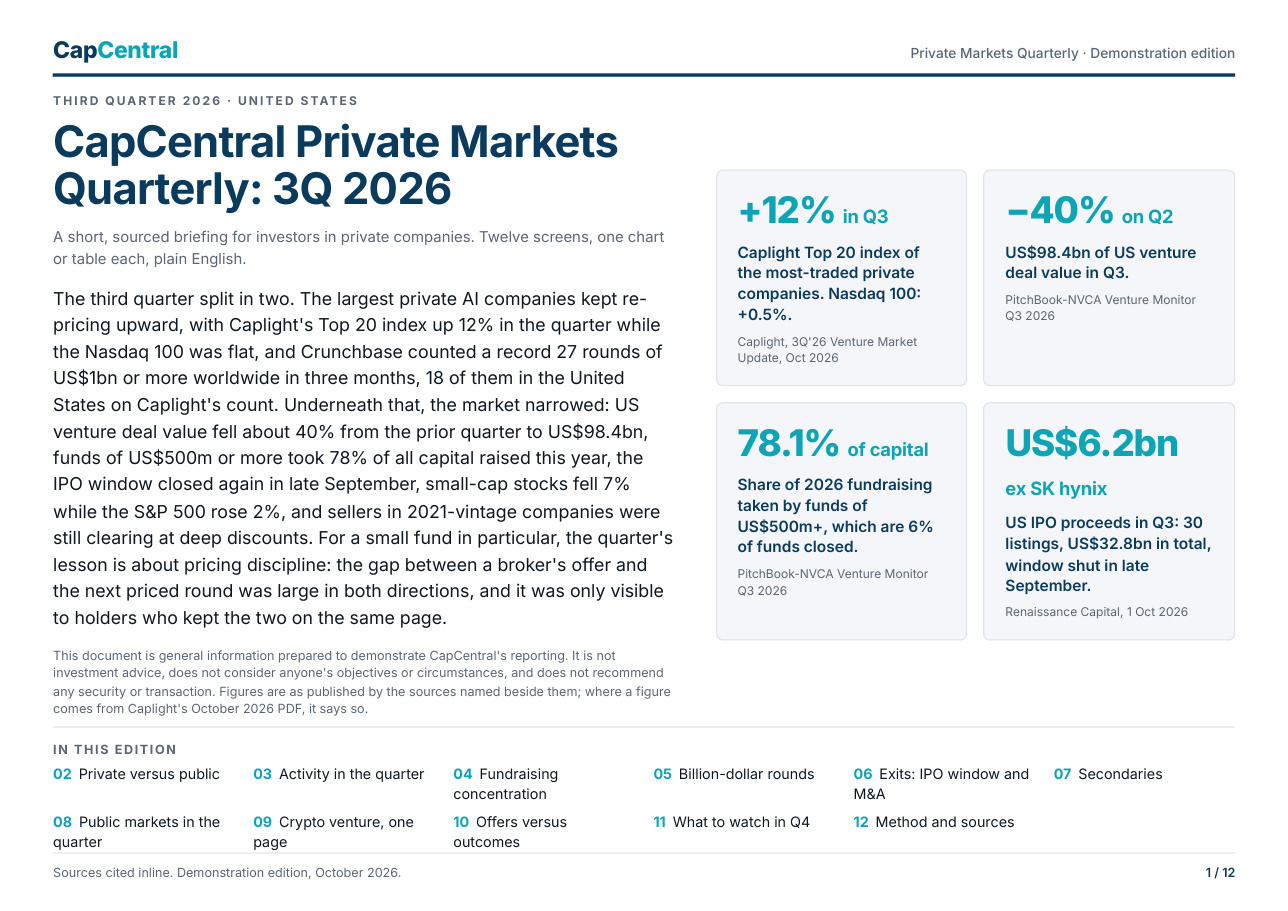
CapCentral Private Markets Quarterly
Where private-market money went, what cleared at what price, and how broker offers compared with the rounds that followed. Every figure sourced; the register pages are ours alone. The 3Q 2026 edition is out now.
Done. The 3Q 2026 edition is on its way, and the next one each quarter.
One email a quarter. Nothing else.
Questions people ask.
Is this fund administration or a portfolio tracker?
Neither. Your administrator strikes the official NAV and your registry holds the register; CapCentral reads their statements, reconciles them to its own model and gives you the daily view on top. Built for people who run money for others.
Which structures work today, and what if mine is different?
Unit trusts with one or more classes, family offices and individual accounts in their base currency, and US limited partnerships in profile view, with LP capital accounts and TVPI, DPI and IRR next. New vehicle and asset types are added quickly; tell us what you run and we will show you before you commit.
Who can see my data?
Only people with a seat in your organisation. Pooling is opt-in and covers dated facts only (a round, an offer price, a call), never files, names or positions. You set the rule per document.
Where do prices come from?
Listed prices are delayed market data licensed for display. Private marks come from closed rounds, offers, secondary indications and public fund filings, each with its source and date. Nothing is a recommendation.
Can I connect my broker?
Interactive Brokers statements can flow in nightly; other brokers by statement forwarding or file drop. Private positions arrive from the subscription paperwork you forward to your fund's inbound address.
Join the waitlist.
Version 1 is in private testing with four demonstration funds. Tell us what you run and we will be in touch with one you can click around.
Thanks. You are on the list; the 3Q 2026 quarterly will reach you first.
No spam, no sharing of your address. One email when version 1 opens and one each quarter with the report.